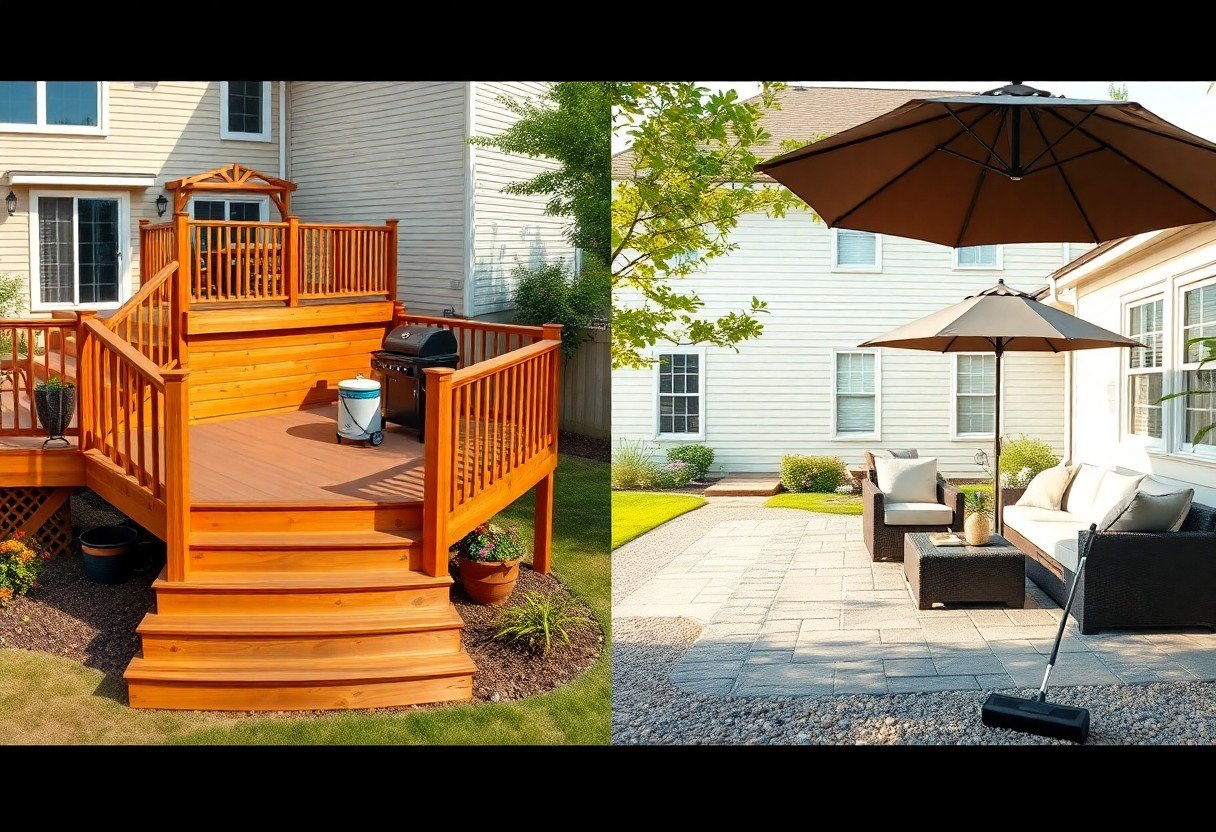
Most homeowners find that a well-built deck often boosts resale appeal while a durable patio offers lower maintenance; you should weigh local market preferences, materials, and upkeep costs to decide which adds more value and fits your lifestyle.
Key Takeaways:
- Patios generally deliver higher resale ROI than decks, with concrete or paver patios often recovering a larger share of their cost at sale.
- Decks add usable elevated living space and curb appeal, but wood decks require more frequent maintenance (staining, sealing, board replacement).
- Material choice controls maintenance needs: composite decks lower upkeep but raise upfront cost; concrete and pavers need occasional sealing and weed control but last longer.
- Site and climate influence the better option: decks work well on sloped or raised sites, patios fit flat yards and drier climates.
- Decks usually cost more and may require permits, railings, and structural work; patios tend to be cheaper per square foot and simpler to install and maintain.
Analyzing Return on Investment (ROI)
You should weigh initial costs, projected lifespan, and maintenance when comparing deck and patio ROI to determine which adds more value for your budget.
Resale value of wood vs. composite decks
Wood often appeals to traditional buyers, but you may recover a smaller percentage of cost over time compared with composite, which reduces upkeep and lasts longer.
Market demand for stone and paver patios
Local markets that value low-maintenance outdoor living boost demand for stone and paver patios, so you can often justify higher asking prices.
Climate shapes material performance and buyer preferences: you’ll find stone and paver patios favored where freeze-thaw and drainage matter, while composites attract buyers in humid or coastal areas for rot resistance. You should also factor in local style trends, seasonal use, and expected maintenance when estimating how market demand will affect resale and price recovery.
Comparative Installation Costs
| Deck | Patio |
|---|---|
| You often face higher material prices for composite or hardwood decking. | You typically pay less per square foot for concrete or pavers. |
| You need skilled carpentry and more labor hours for complex builds. | You hire specialized concrete or paver crews and sometimes heavy equipment. |
| You may avoid extensive grading if the deck sits above grade; pier footings are common. | You usually require more grading, base compaction, and drainage preparation. |
Material expenses and labor requirements
You typically pay more per square foot for composite or hardwood decks and for carpentry labor; patios often have lower material costs but may need skilled concrete or paver installers, balancing cheaper materials with specialized labor.
Site preparation and grading complexities
Expect uneven ground to raise costs for both options; decks can sit above grade to avoid grading while patios require more grading and base work, affecting timelines and budgets.
Unseen issues like tree roots, poor soil, steep slopes, or drainage problems can force additional excavation, retaining walls, or engineered bases, so you should budget for soil removal, permits, and possible utility relocation-contractors may charge more to resolve these site-specific complications safely.
Maintenance and Long-Term Durability
You should weigh upkeep demands-wood decks need regular sealing and inspections, while patios require joint maintenance and occasional repointing to protect value and longevity.
Sealing and staining requirements for wood structures
Wood decks need sealing every one to three years depending on exposure; you should stain, inspect fasteners, and replace damaged boards to prevent rot and fading that lowers appeal.
Weed prevention and structural integrity of masonry
Masonry patios resist rot but you must control weeds between pavers, repair shifting stones, and ensure proper drainage to avoid trip hazards and undermined joints.
When you install a masonry patio, compact the base, set pavers on a stable bedding, and use polymeric sand to lock joints and limit weed growth and frost heave. Regularly inspect joint mortar, pull roots promptly, and address any settling quickly so you avoid larger repairs and preserve the patio’s structural performance and resale impact.
Terrain and Structural Considerations
Site conditions dictate whether a deck or patio adds value and how you must prepare drainage, foundation, and access; you should assess soil type, slope, and local codes before choosing materials.
Adapting to sloped vs. level landscapes
Sloped yards often require retaining walls, raised decks, or terraced patios, so you’ll face higher installation costs and more maintenance; level yards let you install flush patios or low decks with easier upkeep.
Load-bearing capacities and safety standards
Assessing joist sizing, beam spans, footing depth, and connection hardware tells you whether a deck will safely carry people, furniture, or hot tubs; patios need proper base compaction and frost considerations to prevent settling.
Check local codes for required live loads (typically 40 psf for residential decks), minimum guardrail heights, and footing specs, and you should consult a structural engineer when spans, heavy equipment, or unusual soils increase risk.
Climate Impact and Material Longevity
Climate dictates material lifespan: in humid areas you face faster rot and mold on wood decks, while hot, dry sun fades composite and leads to thermal expansion. You should weigh expected weather patterns when choosing deck or patio materials to maximize long-term value and reduce replacement costs.
Resistance to moisture and rot in elevated decks
Wood decks are most vulnerable to moisture; you must inspect fasteners and flashing regularly to prevent rot. Composite and treated lumber resist decay better, but trapped moisture still shortens lifespan. You can reduce risk with proper ventilation, water diversion, and timely sealing.
Freeze-thaw cycles and surface cracking in patios
Patio surfaces suffer when freeze-thaw cycles force water into joints, causing expansion and cracking; you should choose dense pavers and proper drainage to minimize damage.
When temperatures dip below freezing, water in joints and bedding expands and contracts repeatedly, loosening adhesion and opening hairline to larger cracks you will spot over seasons. You can mitigate this by using frost-rated pavers, flexible jointing compounds, a well-compacted base, correct slope for runoff, and timely resealing to prevent moisture infiltration.
Permitting and Regulatory Requirements
Permits and local approvals shape whether you need plans, inspections, or exemptions for decks versus patios – check specifics in resources like Deck vs Patio [2025]: Which Adds More Value to Your Home? before budgeting.
Building codes for elevated platforms and railings
You must meet building codes for elevated platforms and railings, including load ratings, guardrail heights, stair dimensions, and required inspections before occupancy.
Zoning restrictions for ground-level hardscaping
Check zoning rules for setbacks, impervious coverage, easements, and HOA covenants that may restrict patios or require permits and neighbor notices.
Local ordinances can control drainage, tree protection, nighttime lighting, and allowable materials, so you should submit site plans and confirm stormwater requirements with your municipal office.
To wrap up
The choice depends on your priorities: a well-built deck often boosts perceived value and offers design flexibility, while a patio typically requires less upkeep and lasts longer. You can expect composite decks or stone patios to be easiest to maintain, and local market preferences will determine which adds more resale value.
FAQ
Q: Does a deck or patio add more value to my home?
A: Decks often deliver higher perceived value because they create elevated outdoor living space and extend usable square footage. Patios can add comparable value when made from high-quality materials like natural stone or brick and when they fit the property and neighborhood. Return on investment varies by local market and material choices, with typical recoup ranges overlapping for both options.
Q: Which is easier to maintain: a deck or a patio?
A: Patios generally require less routine maintenance, especially poured concrete, stone, or paver installations that need occasional cleaning and joint care. Wood decks demand regular cleaning, staining or sealing every 2-4 years, and inspections for rot or loose fasteners. Composite decks reduce maintenance compared with wood but still benefit from periodic washing.
Q: How do climate and yard conditions influence which option to choose?
A: Wet or humid climates favor nonporous materials such as concrete, pavers, or composite decking because they resist moisture-related decay. Sloped or uneven yards often make a deck the practical choice due to built-up structure and easier grading. Freeze-thaw regions require frost-protected footings for decks and proper base and drainage for patios to avoid movement and cracking.
Q: What are typical cost and lifespan differences between decks and patios?
A: Cost per square foot varies widely: basic wood decks often range from moderate to lower cost, composite decks carry higher upfront cost, poured concrete patios are usually least expensive per square foot, and pavers or natural stone cost more. Lifespans depend on material and care: properly maintained wood decks can last 10-30 years, composite decks 25+ years, concrete patios 25-50 years, and well-installed pavers 30+ years.
Q: Which should I choose to maximize resale appeal while minimizing upkeep?
A: Choose a deck when you need elevation, views, or a structure that adds distinct outdoor rooms; choose a patio when you want low maintenance and long-term durability. Select high-quality materials, hire experienced contractors, and keep the area clean and repaired to preserve value. Match the design to neighborhood expectations and local buyer preferences to improve resale appeal.